
Kalamazoo, MI · Garage Door Service
Why a Door Goes Off Track in Kalamazoo
Kalamazoo's 1960s-70s housing stock and severe cold winters put real strain on track alignment. Here's why doors here jump track more than newer builds elsewhere.
- Repairs & new doors
- Springs & openers
- Serving 7 nearby communities
What Local Conditions Do
Most houses standing in Kalamazoo went up between 1938 and 1993, with the median build year sitting right around 1969. That means the tracks on a huge share of doors in this service area are original or close to it, mounted to jamb framing that's had fifty-plus winters to settle. Settling shifts the vertical track out of plumb by fractions of an inch, and a door doesn't forgive fractions of an inch.
Kalamazoo sits in a severe cold climate band, and that matters for track alignment specifically. Cold makes steel brittle and grease stiff, so rollers that would ride smoothly in October start binding in January. A roller that binds doesn't travel the track evenly. It skips, catches, and over a season or two it walks the track off its mounting brackets. This isn't a one-town-is-worse-than-another thing in the abstract - it's that this town's housing age and this climate band stack the same way on nearly every street from the Northside down to South Westnedge.
Houses in the 25 named areas across this service area, built mostly in the 1960s and 70s, share the same track hardware generation. When one goes off track, the neighbor's door on the same block is usually not far behind.
What Most People Get Wrong
The common assumption is that a door jumps track because something hit it - a car bumper, a kid's bike, a gust of wind catching it open. Sometimes that's true. But on houses from this era, the more frequent cause is slower and less dramatic: the track brackets loosened from decades of thermal cycling, the wall framing shifted a hair, or cold-stiffened rollers finally stopped tracking true on hardware that was never built with modern tolerances.
People also assume a bent track is a quick bend-it-back fix. On a track this old, the metal has already fatigued from forty or fifty winters of expansion and contraction. Bending it back gets you a track that looks straight and still runs rough, because the metal doesn't return to its original temper. It usually goes off again within months.
The other mistake is waiting for warm weather to deal with it. Cold is when misalignment shows up worst - stiff springs, stiff rollers, more resistance against a track that's already slightly out of true. Putting it off from December to May means living with a door that's one more cold snap from coming off the rail entirely.
What Is Going On
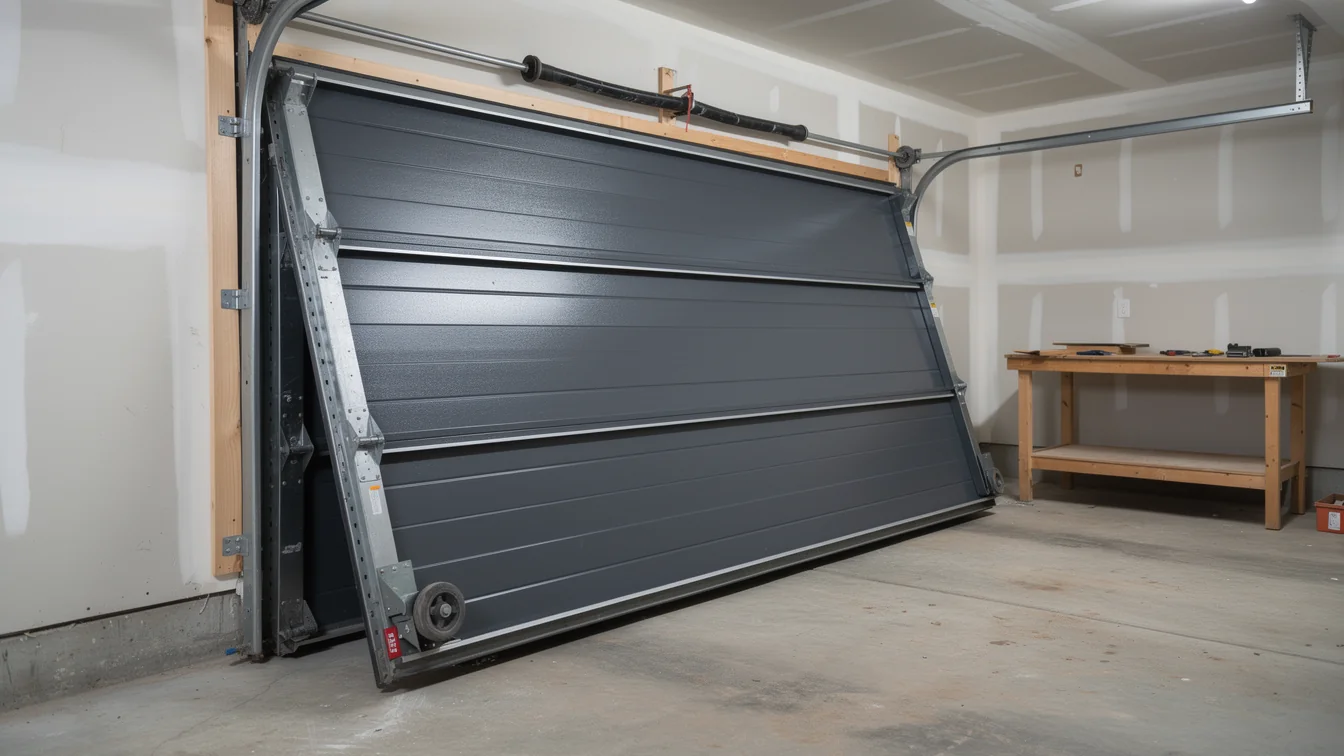
When a door goes off track, it's almost always one of three things working together, not one thing alone. First, the track brackets - the ones lag-bolted into jamb framing - have worked loose. On houses built in the 1960s and 70s that framing has seen decades of seasonal movement, and lag bolts back out a little at a time. Second, a roller has worn down or seized, so instead of rolling smoothly it drags and forces the door to push sideways against the track instead of straight up. Third, the track itself has a bend, usually from age-related fatigue rather than a single impact, and a bent section catches rollers every pass until one of them finally jumps the rail.
In the cold months here, all three get worse at once. Stiff grease means more drag on a roller that's already marginal. Contracted framing means brackets that were marginal are now loose. A door that tracked fine in August can go off track in January on the same hardware, same house, no new damage - just winter doing what winter does to fifty-year-old steel and wood.
Leaving It Alone
A door that's slightly off track but still closing is not a door you should keep running day after day. Every cycle on a misaligned track puts more load on the cable, the rollers, and the opener motor, and on original-era hardware that load has nowhere good to go. We've seen it end in a cable jumping its drum or a bracket tearing loose from the jamb mid-cycle, which is a heavier repair than catching it early.
Here's the honest limit on this: if the track is bent in more than one spot, or the bend is sharp rather than a gradual bow, we're not going to recommend hammering it straight and calling it fixed. Fatigued, old-gauge track gets replaced, not reshaped - it's a cheaper call in the long run than a callback for the same door in six months. We'll tell you straight when a repair isn't worth it versus swapping the track section. Across the roughly 23,763 owner-occupied houses in this area, that's the call we make most often on doors from the original building era.
Frequently asked questions
Why does my garage door only jump track in winter?
Cold stiffens the grease in the rollers and makes the steel track less forgiving of small misalignments. On houses built in the 1960s and 70s, which make up most of this area's housing stock, the brackets have also had decades of seasonal movement to loosen slightly, so the combination shows up hardest when temperatures drop.
Can a bent track just be bent back into place?
On newer track, sometimes. On track that's run for forty or fifty winters, the metal has already fatigued and won't hold a true line once bent back. It usually drifts off again within a season. We'll check the gauge and the fatigue before recommending a straighten versus a replacement.
Is a door off track an emergency?
It's not always a same-hour call, but it's not something to keep running either. Every cycle on a misaligned track adds strain to the cable and opener. If the door still closes but drags or catches, get it looked at before it comes off the rail entirely.
Does the age of my house affect this?
Yes. Most houses in this service area were built between 1938 and 1993, with the bulk from the 1960s and 70s. That means original or early-replacement track hardware on a lot of doors, which wasn't built to the same tolerances as current track.
Related garage door services in Kalamazoo
More garage door guides
Book garage door service in Kalamazoo
Call now or request a quote - tell us what the door is doing and where you are.