
Kalamazoo, MI · Garage Door Service
Panel Replacement for Eastwood's 1950s Garage Doors
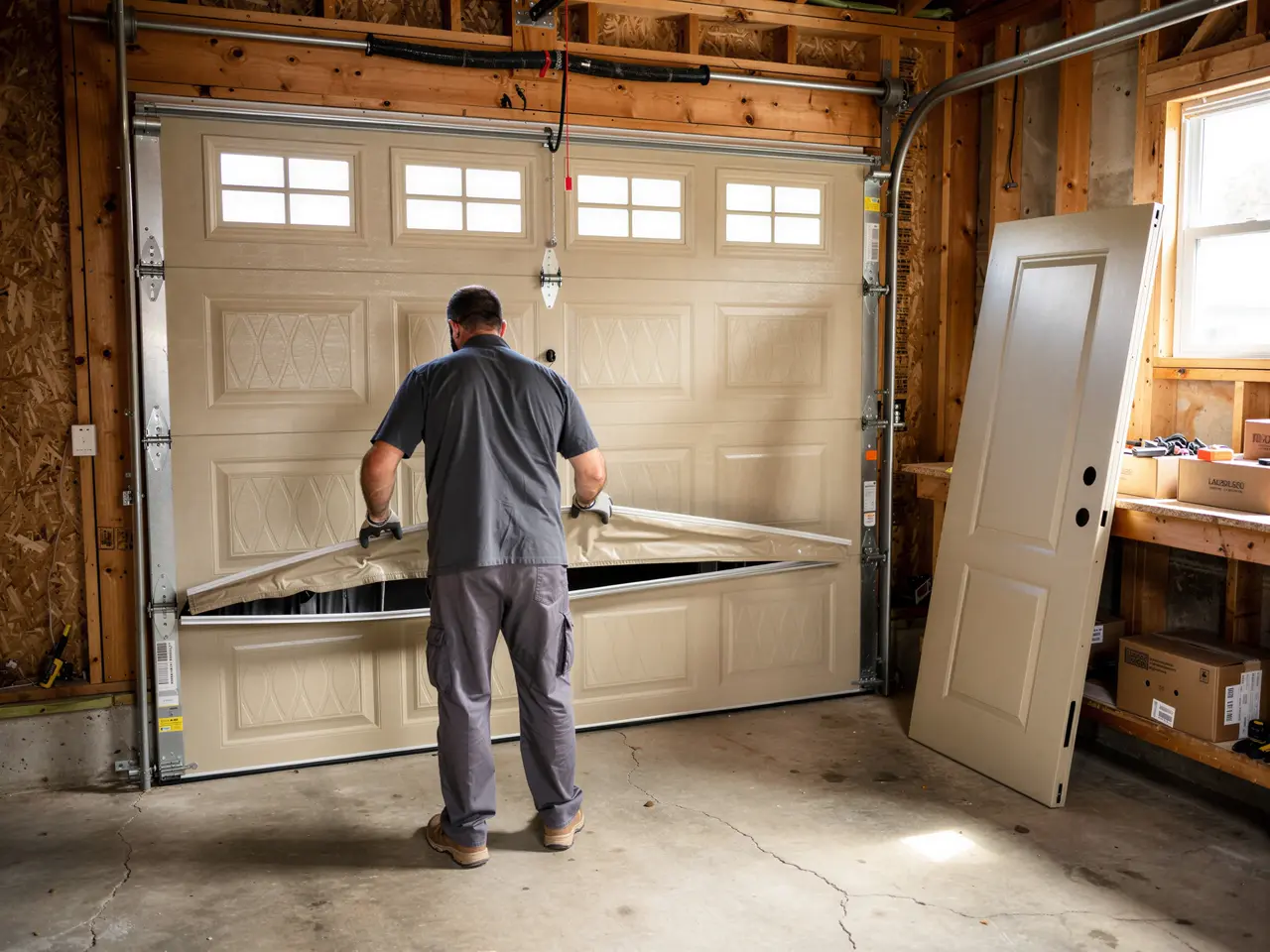
Eastwood has about 2,879 households and most garage doors date to the mid-1950s. Here's what panel replacement looks like on this housing stock and what it runs.
- Repairs & new doors
- Springs & openers
- Serving 7 nearby communities
Time on the Job
Eastwood is a small pocket of the Kalamazoo area, about 2,879 households packed into a stretch three miles from downtown. That size matters more than it sounds like it should. A neighborhood this compact tends to have been built out in waves rather than over decades, and Eastwood's wave landed around 1955. That means the garage doors we get called out to aren't a random mix of eras - they cluster tightly around one generation of hardware and one generation of door construction. A crew that knows what a mid-1950s Eastwood door looks like under the skin gets in and out faster than one guessing at it, because the panel sizing, the track width, and the fastener pattern are predictable before the truck even pulls up. We're coming from Kalamazoo, not from a depot in Eastwood itself, so we plan the visit around diagnosing the actual damage first rather than assuming a stock part will drop right in. On a door this old, it rarely does without some fitting.
What It Costs
We don't have an Eastwood-specific price list to quote here, and we're not going to make one up. What we can tell you is that cost on a panel job swings on two things: whether the door is a common modern size or an older non-standard one, and whether we're matching one panel into an existing run or replacing the whole section. Eastwood's housing stock, built mostly in the mid-1950s, leans toward the second category more often than newer subdivisions do - doors from that era weren't always built to the panel dimensions manufacturers standardized around later. That mismatch is usually what separates a straightforward swap from a job that needs custom trimming or a matched reorder. Median household income in the broader service area runs just over $70,000, but Eastwood itself sits lower, around $50,054, which is worth mentioning only because it's often the reason a homeowner here asks us to repair a single damaged panel instead of replacing the whole door - a fair question, and one we'll answer honestly on site rather than upselling a full replacement nobody asked for.
The Complications
The complication in Eastwood isn't the door going bad - it's what's attached to it. A door from 1955 was almost never built with the hardware setup that later became standard, and over nearly seventy years a lot of these doors have had one or two repairs already, done with whatever parts were on hand at the time. That history makes panel replacement more of a puzzle than a plug-and-play swap: we're often matching new material to an older gauge of steel, a different rail profile, or hinges that were never quite the stock size to begin with. On top of that, this is a cold-climate service area, and a door built before modern weatherstripping and insulation standards existed wasn't designed with today's thermal expectations in mind. Replacing one panel on an otherwise untouched 1955 door can also expose how tired the rest of the door is - something we'll flag rather than ignore, because a new panel bolted to a failing track or a spring that's near the end of its life doesn't solve the actual problem.
How We Fix It
We start by identifying what era of hardware we're actually working with, since a door built around 1955 rarely matches a parts catalog built for 1990s or 2000s doors. From there it's a measure-twice job: panel width, rail depth, hinge spacing, and whether the existing track can take a modern panel without modification. If the door is a common size despite its age, we can usually drop in a direct replacement. If it isn't - which happens often enough on this side of the service area that we plan for it - we either source a panel that can be trimmed to fit or walk you through why full replacement makes more financial sense than chasing a one-off match. We won't pretend every older door panel can be repaired instead of replaced; sometimes the steel underneath is too far gone and patching it would just mean another call in a year. That's the honest answer, even when it's not the one that gets us the smaller job.
Stocked Parts
We carry common panel sizes and the fasteners and hinges that go with current door lines, since that covers most of what the broader Kalamazoo-area housing stock needs. What we don't keep on the truck is a shelf of parts sized for doors built before current manufacturing standards existed, which includes a good share of what's installed in Eastwood. For those jobs, a part often has to be ordered to match the specific door rather than pulled off the shelf that day. We'll tell you up front if your door falls into that category instead of promising a same-visit fix we can't deliver. It's a limitation worth knowing about before you schedule, not after the crew is already there.
What Causes It Around Here
Across the Kalamazoo service area the housing stock runs from 1938 to 1993, with a lot of it clustered in the 1960s and 70s. Eastwood sits earlier than that median, with most homes going up around 1955, which puts its garage doors among the oldest in the area we cover. Age alone causes plenty of panel damage - steel that's been expanding and contracting through decades of cold-climate winters eventually fatigues at the seams and dents stay dented instead of springing back. Add in a service area climate band rated cold and severe, and the freeze-thaw cycle on a nearly seventy-year-old panel does more work than any single impact ever could. We also see damage from cars clipping a door on a tight Eastwood driveway, which isn't a climate issue so much as a layout one - small lots built close together in the 1950s didn't leave much margin for error backing out.
Frequently asked questions
Is my Eastwood garage door too old for a standard replacement panel?
Possibly. A lot of Eastwood homes date to around 1955, and doors from that era weren't always built to the panel sizes that became standard later. We measure on site before ordering anything - if your door is a common size we can match it directly, and if it isn't, we'll tell you what your real options are.
Do you keep a branch or stock parts in Eastwood?
No. We work out of Kalamazoo and travel to Eastwood for jobs, about three miles each way. We don't claim a local depot or a guaranteed response time here, and parts for older, non-standard doors are often ordered to match rather than pulled from the truck same-day.
Should I replace one panel or the whole door?
It depends on the door's age and condition. On a door built in the 1950s, a single new panel can look and perform differently from decades-old steel next to it, and the rest of the door may be close to needing attention anyway. We'll give you a straight answer on site rather than defaulting to the bigger job.
Book garage door service in Kalamazoo
Call now or request a quote - tell us what the door is doing and where you are.